How to Cope with Debt

Coping with debt is a skill.

For those of us with crushing long-term debt that it will take us years to pay off, coping with debt is a skill that could save our lives. While we are working our multiple jobs and side hustles,  making more money and cutting expenses, we need to realize that dealing with debt is more than a numbers game.

taking-a-walk1

1. Breathe, Stretch, & Take a Walk

I know it sounds trite, but do it. Really. The stress of debt can be deadly. It has been linked to depression, chronic hypertension, migraines, digestive problems, heart and autoimmune diseases.  Get outside and get some sun. Deep breathing clears the lungs and lowers blood pressure. Stretching and moving increases healthy blood circulation. Taking a brisk walk strengthens the heart and exercises tense muscles. We all know how exposure to sunlight is very good for mood and natural vitamin D production.

girl writing

2. Start and Maintain a Debt Diary

When behind the bars of debtor’s prison, write. Write to save your sanity and your health.

Get a good old fashioned paper diary, regular notebook, Word/Google doc, or even a blog – whatever works for you. This diary / journal / logbook is where  you can vent about all the slights, put-downs, and insultiments you endure on a regular basis. Everytime you have your intelligence insulted on your job, write about it. Everytime you endure a desperation filled and humiliating job interview, write about it. Everytime you get snubbed by family, friends, or strangers, write about it.

Just told someone off because you couldn’t take it anymore – record it here for history. Found out that your  cousin who barely graduated high school/college married a doctor and is now on holiday with him in Europe?  Grind your teeth while you look for your bus pass.  The only place you can afford to go is to work! What about your classmate whose parents helped him start a business and who now works for himself.  Grind your teeth, and buy a dental guard from the store to avoid a nasty dentist bill, while on your way to your second job.

Write about these encounters, feel them, and get them out of your mind and down on paper – every detail. Don’t keep things bottled up. It leads to illness. Write about what happened, who said what, who did what, how the incident ended, and how it made you feel. Vow that once out of debt that this will not happen again. Then think about concrete actions that you can take to prevent it from happening again.

film-reel-df997

3. Sit Back for Cinema Therapy

Cinema therapy gives us a chance to make sense of our own financial situation by seeing it reflected in the lives of others. For some, distance provides perspective. There a few different forms of cinema therapy.

Library-Books

4. Catch the Reading Rainbow

Whether nonfiction books, fiction novels, or blogs, read things that educate, entertain, or edutain you about personal finance, minimalism, frugality, and lifestyle design. Don’t overlook the fiction genre. One entertaining fiction book about sudden unemployment that I enjoyed recently was Bitter is the New Black. Check it out from your local library. You do patronize your FREE local library, right?
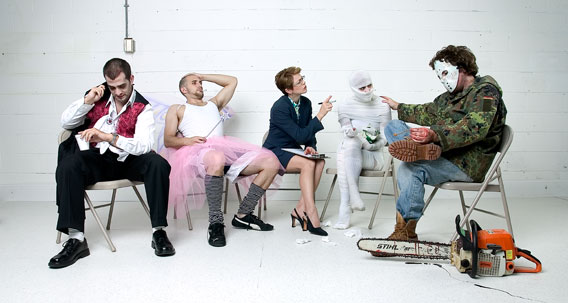
group_therapy

5.  Join a Personal Finance/ Debt Therapy Group

Don’t want to bother your friends and family with another diatribe or cry session? Has your debt diary started yelling back at you to stop harassing it? You may be the perfect candidate for group therapy. There are online and face-to-face groups available for the joining. Dave Ramsey’s Total Money Makeover Forums, Early Retirement Extreme Forums, local meetup groups, and countless others can give you the support you need to vent and strategize ways out of debt. Drag those scary financial skeletons out of the closet. No local face-to-face groups in your area? Start one on Meetup.com.

drugs

6. Reduce or eliminate the junk

Didn’t think I’d let you off the hook that easily, did you? We all know the drill. Cut out, or at least cut down, the sugar, alcohol, and fried foods. Don’t self-medicate with drugs, or alcohol. We all know that it will cause more and worse problems down the line.

There you have it. These are a handful of ways to begin coping with long-term large debt, while we actively work to claw ourselves out of it as fast as we can. I’m working on these myself. It’s not easy.

What are some ways that you cope with your large debt?

.

“Debtor’s prison is real, and opportunity cost is a bitch.” (DDSW)
5 Reasons Why People Practice Extreme Frugality and / or Minimalism

I’ve been considering why some of us are drawn to (extreme) frugality and/or minimalism. I have identified five reasons or triggers for these practices. You may identify with all of these possible causes or none.  If we maintain this way of life for many years, we may move between these reasons as our circumstances change. I am not a psychologist or behavioral economist, so these are just my personal observations and opinions. Note that frugality and minimalism are NOT the same thing. I pair them here for the sake of simplicity.

bitterness

#1. Reflexive Resentment

You couldn’t turn things around now you’ve lost it all. Your debts and financial situation have caught up with you, and you can’t run and hide anymore. The facade has crumbled.  You’ve hit a low point and need a way to cope with your situation. You turn all that sadness, disappointment, and embarrassment into anger and resentment.  You had to sell a lot of your possessions. The things you have left mock you. As a reflex and as a way to protect your ego, your sense of self, you begin to see the things that you no longer have, the things you could no longer have, as a useless waste. In your mind, if you can’t have it, then you don’t want it.  You dislike owning things now. You see stuff as weight that keeps you tied down. You dislike spending money. You may not even have much desire to travel anymore when it used to be all you thought about. You reduce your living expenses and lifestyle in a way that rejects what you used to value and spend money on.

For instance, some people practice minimalism as a way to reduce anxiety and stress by reducing the number of things in their life. That means, fewer things to search for, buy, store, clean, insure, and maintain, etc. It can be a way to assert control over one’s environment, particularly if it is felt that other parts of life are out of control.

In addition to resenting things, you also resent yourself for thinking that you had a shot at a better life. You resent yourself for being so financially ignorant and gullible with regard to money. While you may love your family, you may resent them for not teaching you to protect yourself from financial predators. You resent that you, without knowing any better, allowed yourself to be financially taken advantage of.

You don’t want status symbols and stuff anymore. Some may call it sour grapes. Others may call it a symptom of depression. I’m not a psychologist, but it seems that while this may help one cope in the short term, if it goes on long term, it may not be the healthiest perspective and could slip into mental illness if not regularly measured against healthy boundaries.

trauma

#2. Psychological Trauma

Similar to #1 (reflexive resentment) but more sudden and severe. Whereas #1 may take place over a period of months or years where one’s financial situation deteriorates, #2 psychological trauma, happens suddenly. Usually a job loss, a large negative legal judgement or expense, divorce, or a grave and costly medical diagnosis turns your life upside down in one moment.

Your safety net and security are snatched from underneath you before you can steady yourself or put plans in place. You may find yourself  days or hours away from being homeless, or you may find yourself actually being homeless. These experiences can cause psychological trauma that can last a lifetime. In its extreme form, the result can be an unhealthy relationship with money and ownership of things.

We all know the story of Kate Hashimoto from “Extreme Cheapskates”. Her obsession with not spending (“wasting”) money was triggered when she lost her job during the dot.com bust. This must have been a traumatic event for her because now, even though she makes a six-figure salary with a big accounting firm, she refuses to spend money on anything. [To anyone who has traveled outside  of  the U.S. and Europe, the things she does to save money are actually commonly done in many parts of the developing world, and are not “weird”.] What is concerning however, is that she and others in this category do some things that put their health at risk when they have more than enough money to not have to do that.

Return-On-Investment

#3. ROI – It’s Business 

You find frugality and/or minimalism to be a strategic financial pathway to achieve some life goal, such as extreme early retirement.  You have calculated that if you reduce your expenses and possessions for a period of time now, you can divert that money to savings and investments that will allow you to retire early, start a business, or travel the world for years.

trendy

#4. It’s Trendy 

You are not experiencing financial hardship. However, with the economy not being what it used to be, and with so many people cutting back, you want to fit in. Perhaps, thanks to a documentary or famous blog, you undertake a 1 month or even a 1 year challenge to buy nothing new, or only spend X dollars, or only own X number of things, or live on minimum wage. For you, it’s about adventure, and accomplishment.

meditation1-300x214

#5. Enlightened Self-Awareness

You embrace frugality and/or minimalism by choice and practice it as an outward manifestation of your own inner peace and self-acceptance. For you, practicing frugality and/or minimalism is not a means to an end. It is not something to be endured. It is a way of life. You have no desire for designer labels, and the accumulation of stuff. You only keep those things that bring you the most value and benefit, and reflect what is most important to you.

.

There you have  it. Those are my five reasons why people are drawn to practicing (extreme) frugality and/or minimalism. Did I forget any? Why do you think people are drawn to this way of life?

.

“Debtor’s prison is real, and opportunity cost is a bitch.” (DDSW)

.

Photocredits:
Bitterness and Resentment – examiner.com
Meditation – astralsociety.net

April 2013 Update: Back from the Dead Edition

medium_8551369496 exhaustion desk

I’m back for a brief update. My credit card balance is still at $24,998. Right now, I need to build up my emergency fund. Why? Well, the last few weeks have been brutal on the job front.

Right when my second job started, I became entangled in an unusually large project at my 9 to 5 job that required more and more time. For the past two weeks I have been working all day, all night, weekdays, and weekends. No sleep. No breaks. Between the two jobs, I was exhausted, stressed out, and at my breaking point.

My relationship with my manager at my 9 to 5 job has been rapidly deteriorating over the past several months, and this past week has been one of the worst. I’m certain that she’s already laying the ground work to fire me. Poor work review in writing (where I’d had none previously), check. Replacement hired, check. Oh yes, she’s hired someone new to “join” the team, but it’s obvious to me that this person will be replacing me.

I’ve realized that I’m better suited to working “in-house” at a company than working for clients.

I’m literally waiting for the axe any week now.  I have a standing monthly meeting with her next week, and it will not be pretty. If I walk out of there with my job I will be surprised. In the meantime, I’m submitting applications to various places and have already had one phone screen.

Buckle-up. It’s gonna be a bumpy ride.

.

“Debtor’s prison is real, and opportunity cost is a bitch.” (DDSW)

.

photo credit: Cristiana Gasparotto @ flickr, “Exhaustion”, Creative Commons 2.0